
If you have Medicare and want help with your weight, you may have more options than you think. Medicare covers weight-loss counseling in primary care for people who qualify, and a temporary program called the Medicare GLP-1 Bridge now offers certain weight-loss medicines to some people with Medicare drug coverage. Medicare Open Enrollment runs from October 15 to December 7, so here is how the pieces fit together.
Weight-loss counseling visits
Medicare Part B covers obesity screening and behavioral counseling, which Medicare.gov calls obesity behavioral therapy. To qualify, you must have a body mass index (BMI), your weight relative to your height, of 30 or more. The benefit includes a BMI screening, a dietary assessment and counseling on diet and exercise for weight loss. You must get it from your primary care doctor or another primary care provider in a primary care setting, such as a doctor's office.
Medicare's rules set the schedule:
- One face-to-face visit every week for the first month
- One visit every other week in months 2 to 6
- One visit a month in months 7 to 12, if you have lost at least 3 kilograms (about 6.6 pounds) in the first 6 months
If you have not lost 3 kilograms by the six-month visit, the monthly visits do not continue, and your BMI and readiness to change are checked again after another 6 months. Medicare.gov says you pay nothing for this counseling if your provider accepts assignment, which means accepting the Medicare-approved amount as full payment. If your provider recommends other services, ask whether Medicare covers them, because those can cost you money.
What Part D covers, and what it does not
Medicare drug plans (Part D) do not cover drugs when they are used for weight loss. CMS, the federal agency that runs Medicare, describes them as "agents when used for weight loss" and excludes them from Part D.
GLP-1 medicines can still be covered by Part D for other approved uses. In a June 10, 2026 memo, CMS told Part D plans they must keep covering GLP-1 drugs for uses Part D already covers. Its examples were Zepbound (tirzepatide) to treat moderate to severe obstructive sleep apnea in adults with obesity, and Wegovy (semaglutide) to lower the risk of major heart problems in adults with established heart disease and either obesity or overweight. CMS also lists type 2 diabetes, and MASH, a type of fatty liver disease, with moderate to advanced liver scarring.
The Medicare GLP-1 Bridge
The GLP-1 Bridge is a short-term demonstration run by CMS. It covers certain GLP-1 drugs for weight management from July 1, 2026, through December 31, 2027. It runs outside your Part D plan, but you need Part D coverage to use it, either through a stand-alone drug plan or most Medicare Advantage plans with drug coverage.
You must be 18 or older, and when you start the medicine you must have one of these:
- A BMI of 35 or more
- A BMI of 30 or more plus heart failure with preserved ejection fraction (a type of heart failure in which the heart muscle is stiff and does not fill with blood easily, even though it pumps normally), high blood pressure that stays above 140/90 despite two blood pressure medicines, or chronic kidney disease stage 3a or higher (at least a mild to moderate loss of kidney function)
- A BMI of 27 or more plus prediabetes, a past heart attack or stroke, or peripheral artery disease with symptoms
You are not eligible for the Bridge if you have type 2 diabetes, moderate to severe sleep apnea or MASH, or if you have already received a GLP-1 through your Part D plan. The covered drugs are Foundayo tablets, Wegovy injection or tablets, and the Zepbound KwikPen. The single-dose Zepbound pen and Zepbound vials are not covered. Your provider must certify that you are using the medicine as part of a lifestyle program focused on diet and exercise, and must complete a prior authorization, which is an approval step.
If you qualify, you pay a $50 copayment for a one-month supply. That copay does not count toward your Part D deductible or out-of-pocket limit, and Extra Help cannot lower it. For questions about the Bridge, call 1-800-MEDICARE (1-800-633-4227).
Ready to Get Started?
Primary care, mental health, and addiction medicine in one practice. New patients are often able to be scheduled within a week of requesting an appointment.
5 cards. Swipe or tap to see the next one.
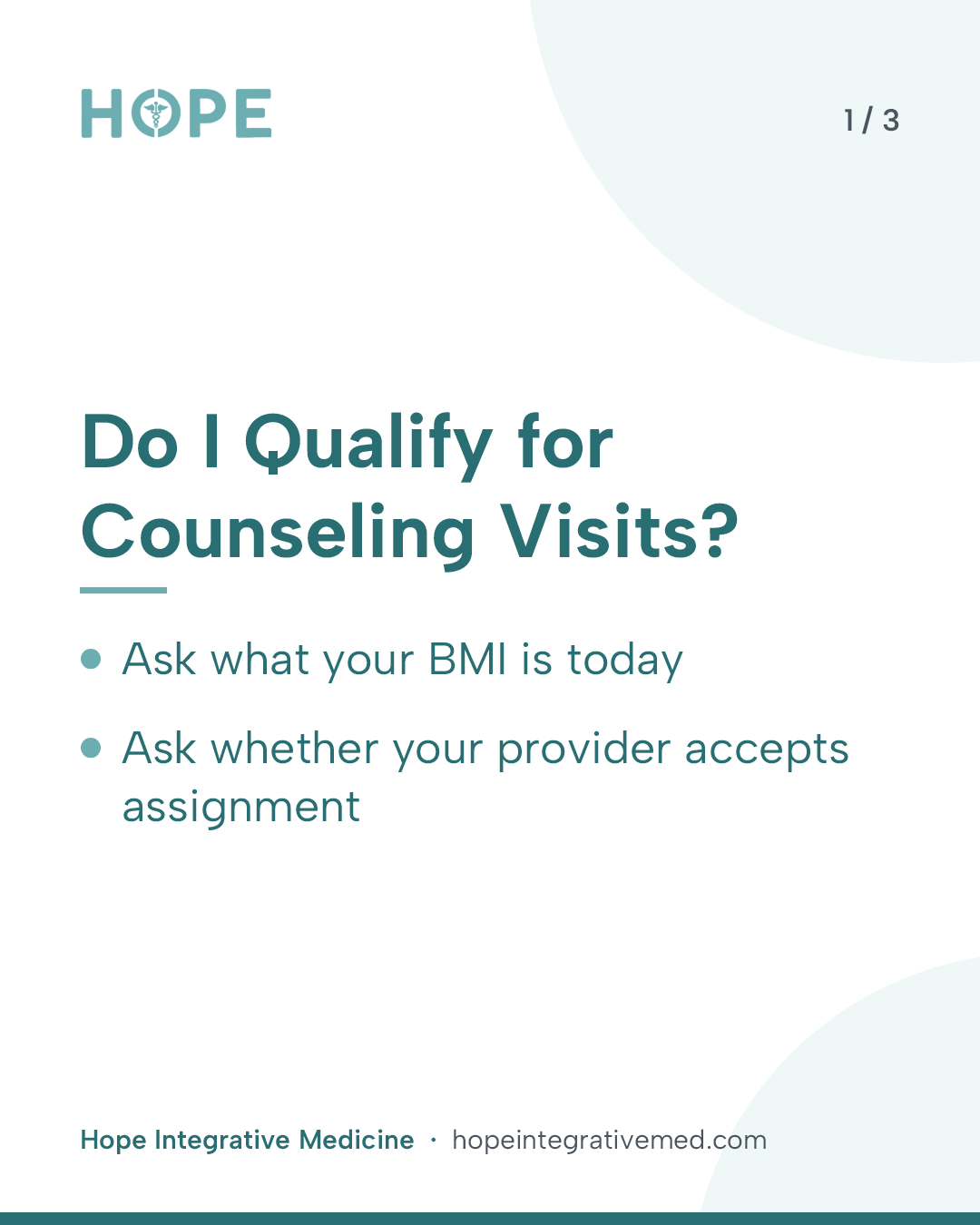
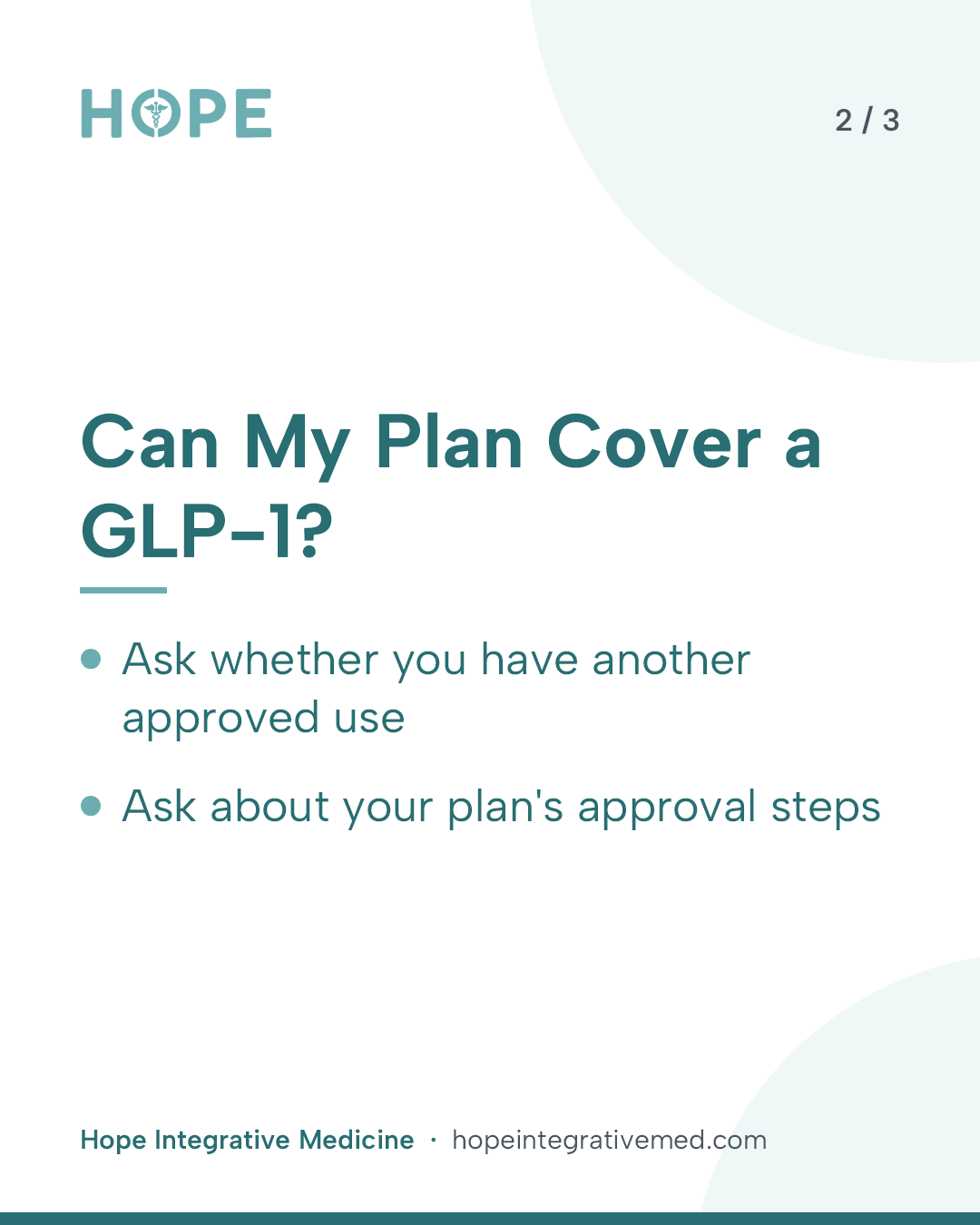
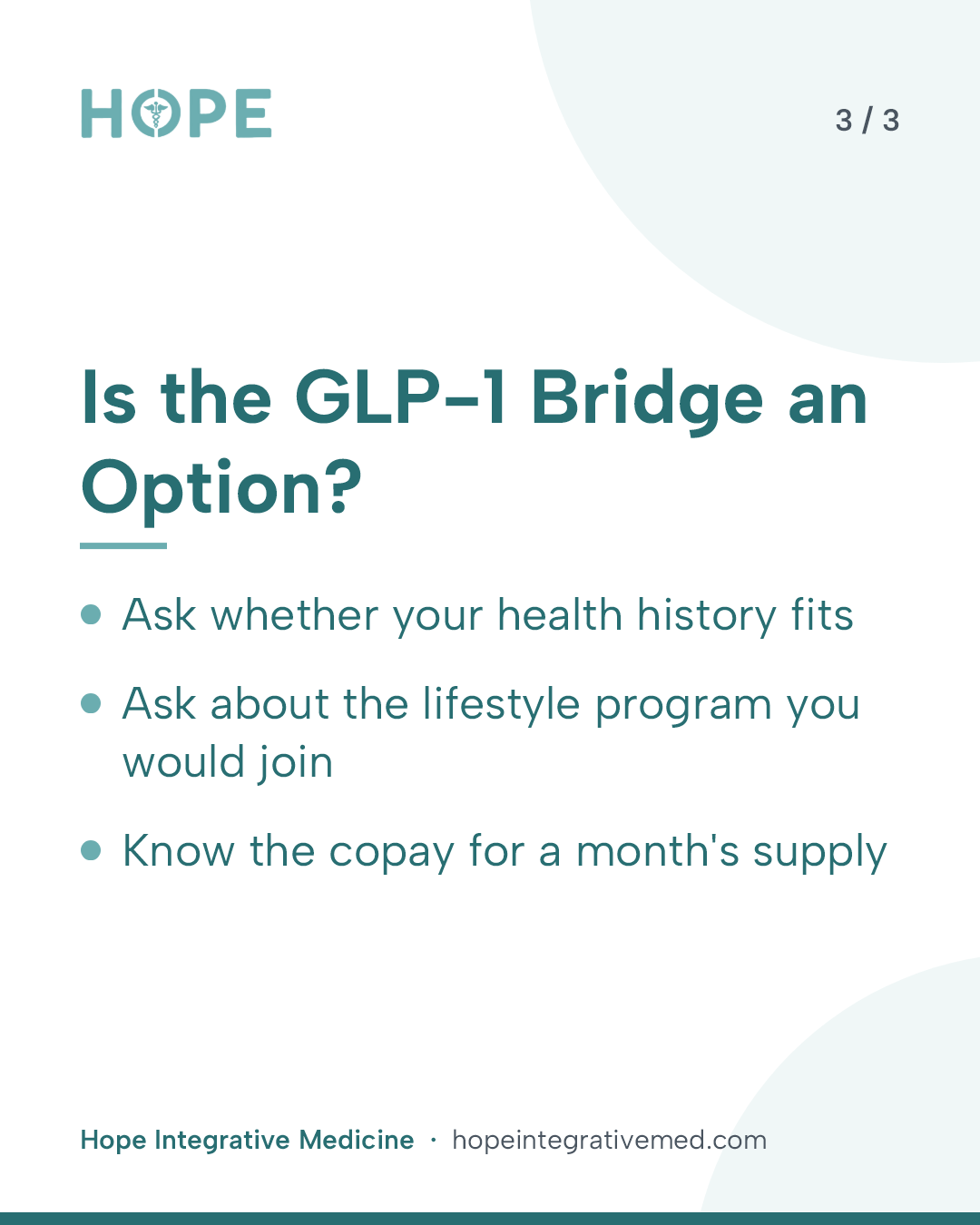
Open Enrollment: check your plan
Changes you make during Open Enrollment take effect January 1. Medicare Advantage plans must cover all the services Original Medicare covers, but many use networks, and out-of-network care usually costs more. If you are choosing a plan for 2027, check that the providers you want to see are in its network.
A question to bring to your next visit
"Which path fits me: counseling visits, my Part D plan or the GLP-1 Bridge?"
Weight care at Hope Integrative Medicine
Our primary care team can check your BMI, review your health conditions and talk through which coverage path may fit you. CMS confirms Bridge eligibility. Our lifestyle medicine care includes nutrition and weight-loss counseling with Jessica Ace, FNP-C, with in-person weigh-ins in West Ashley and virtual check-ins. New patients are often able to be scheduled within a week of requesting an appointment. Request an appointment.
Sources: Medicare.gov, Obesity Behavioral Therapy; Medicare.gov, What Assignment Means;CMS, National Coverage Determination 210.12, Intensive Behavioral Therapy for Obesity (2011);CMS, Medicare GLP-1 Bridge: Expectations and Frequently Asked Questions for Part D Sponsors (June 10, 2026); CMS, Medicare GLP-1 Bridge: Information for Prescribers (June 2026); CMS, Medicare GLP-1 Bridge (2026); Medicare.gov, Medicare GLP-1 Bridge; Medicare.gov, Joining a Plan; Medicare.gov, How to Get Medicare Services.
This article is general information, not medical advice, and does not create a patient–provider relationship. Every situation is different, so see a provider who can evaluate yours and develop a plan of care. Any medication discussed here may not be right for you: the right choice depends on your diagnoses, other health conditions and current medicines, so take medication only as directed by the provider managing your care. If you are ever in doubt about an emergency, call 911 or go to the nearest emergency room.
Frequently Asked Questions
Yes, for people with a BMI of 30 or more. Medicare Part B covers obesity behavioral therapy from a primary care provider in a primary care setting, and Medicare.gov says you pay nothing if your provider accepts assignment.
Medicare drug plans do not cover drugs used for weight loss. Through December 31, 2027, the temporary Medicare GLP-1 Bridge covers Wegovy, Foundayo and the Zepbound KwikPen for a $50 monthly copay for people who meet its BMI and health requirements.
It is a short-term CMS demonstration that runs from July 1, 2026, through December 31, 2027, outside Part D plans. You need Part D coverage, must meet BMI and health criteria, and your provider must certify that you are in a lifestyle program.
People with type 2 diabetes, moderate to severe sleep apnea or MASH, and people who have already received a GLP-1 through their Part D plan. They go through their Part D plan instead.
CMS told Part D plans in June 2026 that they must keep covering Zepbound for moderate to severe obstructive sleep apnea in adults with obesity. Your plan's approval steps still apply.